Why Do Hydraulic Pumps Overheat? P2105 Failure Analysis
Hydraulic pump overheating can cook the fluid, leave varnish on internal surfaces, and damage the rotating group. In this P2105 failure analysis, Lifco examines the inspection evidence, explains how heat was generated during operation or testing, and shows why fluid condition and cooling matter when diagnosing hydraulic pump damage.
Video: P2105 Troubleshooting: What Does Burnt Oil Do to your Pump?

Parker P2105 Hydraulic Pumps stock
What Causes a Hydraulic Pump Or System to Overheat?
Tomas: Hey Fraser, I wanted to follow-up on the P2105 video that went up last week. In general, when overheating in a pump or system is suspected, what/where is the most likely culprit?
Fraser: A relief valve is generally the culprit. It has the highest pressure drop of the most amount of fluid. Thus, the most amount of heat generated.
Tomas: So in our thermostat analogy, "the window" isn't opening? For this pump, you said you believed it was a slow buildup of heat over time (due to the varnishing amount), what would this look like in a relief valve?
Fraser: The thermostat analogy of your home heating system is a terrible analogy for this one unfortunately. What is happening is that there is heat in the house and it is going out the window and cooling. So it would be like saying that when the heat goes out the window, it gets hotter. But in a hydraulic system when something goes from high pressure to low pressure, that energy needs to go somewhere and it leaves the system via heat.
How Does a Hydraulic Pump Compensator Help Prevent Overheating?
Tomas: Can you think of a better visual comparison/analogy to this specific pump's problem?
Fraser: There are big differences between a fluid and a gas when they are changing pressure, due to the expansion capabilities of fluids. Thermodynamics are tricky, I am not very good with it, and it's easy to go down a rabbit hole. The important part is that we recognize that the P2 is a compensating pump, meaning it has a control that can sense when the pressure gets higher than required and reduces its flow. For whatever reason, this pump did not reduce its flow. It was likely engineered to do so and the heat generated was not accommodated. For instance if they set the pump to compensate at 4000 psi but the relief valve is set to 3500, then the pump would never reduce its flow.
Tomas: Why didn't someone catch this sooner? I know most of the damage was invisible/inside the pump, but surely they would've noticed other problems caused by the pump not compensating?
Fraser: Most pumps have no indication of where the swashplate is (ie. if it is compensated). And likely someone wouldn't know what they are looking for anyways. They would have to make changes to the pump setting or the relief valve setting and see if the system pressure changes before they could determine what is causing the problems. In this case it has likely been running hot for a while. Probably nobody touched it, or it wasn't large enough to show up on their electricity bill.
How Do You Cool a Hydraulic System That Is Running Too Hot?
Tomas: This might be a question that shows my newness to Hydraulics, but do they offer any cooling/heat syncs for hydraulic systems like they do for computers?
Fraser: Cooling is a big part of hydraulics
Tomas: Could cooling have helped this pump? Also, what does a standard hydraulic cooling-system look like?
Fraser: Particularly for test stands, because the way they put a load is by generating heat. They aren't doing any work, it's not like we can test the hydraulic components by continuously driving a vehicle up a hill. So they just put a load on using a relief valve and that turns the hydraulic power into heat.
Tomas: Is that how a load is simulated on a test stand? Just with a relief valve?
Fraser: Yes, a two port relief valve will hold the load until it hits a certain pressure and relieve to hold that pressure
Tomas: Interesting, so we actually use this "heat production" to our advantage when testing?
Fraser: No, it is a severe problem. It means we either run the test for a very short period of time, like a couple minutes, and then have to let the oil cool which takes a few hours. Or we run a chiller and cool water which then cools the oil. All very expensive.
Tomas: Back to the seized pistons we saw in the video, would a gear or vane pump be less prone to overheating issues without this possibility for seized/ damaged pistons? Or do their compensating abilities still make them superior for heat management/control? Their as in piston pumps* compensating abilities
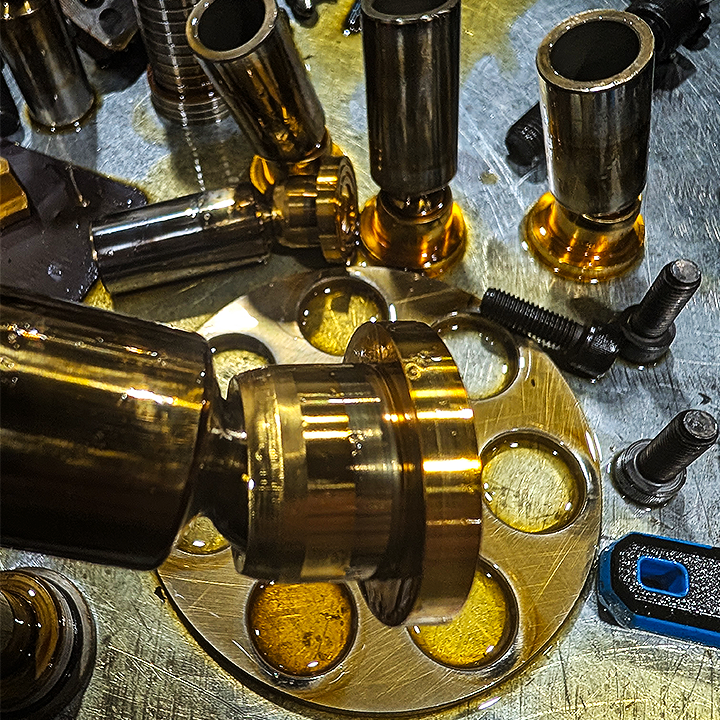
Fraser: The oil was cooked. Cooking it like that is a chemical change which means it was no longer hydraulic fluid. It was not entirely cooked or that would just be a bunch of carbon dust like a campfire, but enough of it was ruined so that it was no longer lubricating internal components.No pump is able to withstand that. But a piston pump is probably on the lower end of ruggedness, and the vane pump is on the high end. The compensating ability is an energy saving feature. Which means that less energy goes into the system and it has less energy to release as heat. So it is very likely (this is entirely a guess though because all I saw was a pump) that the pump was not compensating and more energy was getting put into the system then required.
How Can You Tell If a Hydraulic Pump Failed From Overheating?
Tomas: During inspection, what were the signs that this was overheating, not contamination? I imagine some contamination could appear like dirty/burnt oil
Fraser: No, all signs were overheating: the oil poured out of the housing was cooked. And it had been like that for a while because there was varnish covering everything. Like the discoloration of the wall above an electric baseboard.

What Happens When Hydraulic Oil Gets Too Hot?
Tomas: Once oil is cooked, is there any way to save it? Or is it chemically/fundamentally altered by the heat?
Fraser: Back to grade 9 science Tomas! Chemical changes are very difficult to reverse.This is one of the few situations where you need to replace the hydraulic fluid.
Tomas: I know that aviation applications use special additives to prevent freezing at high altitudes (video coming soon), are there similar additives that can help manage high oil temperature?
Fraser: The weight of the hydraulic fluid is adjusted based on the operating temperature. So that it maintains the correct viscosity for all the components. But it still needs to be under the temperature at which it gets cooked. The principle component of aviation fluid is its fire-resistance with high pressure capabilities (there are much cheaper and easier fire resistant fluids like water-glycol which is used in casting and steel production plants, but they have a lower pressure rating).
Tomas: Is there anything about this pump that stood out compared to other pumps that failed for a similar reason?
Fraser: No, quite unremarkable. Oil got too hot and so the pump lost its lubrication.
Tomas: Did we end up recommending anything to the customer? Because the relief valve was likely the culprit, did they need to replace that or change the settings?
Fraser: We provided the report and they did not provide any feedback. Good chance they knew what was going on because they probably had a few components with problems.
